Baguiati, Kalighat, Bardhaman, Midnapore, Bankura, Arambagh
+91 7477886099



Has a marriage proposal ever fallen through after the families exchanged Kundlis, with someone quietly saying, "there's a Mangal Dosha"? Or perhaps you've heard the word Manglik whispered with a mix of worry and superstition at a family gathering, without anyone really explaining what it means. I'm Anjan Shastri, and over the years, this has been one of the most common - and most misunderstood - questions I've encountered in my chamber.
In this blog, I want to take away the fear around Mangal Dosha and replace it with understanding. As someone who has studied thousands of birth charts over the years from my chamber in Kolkata, I can tell you this with confidence: Mangal Dosha is not a curse. It is a planetary placement - one that, when understood correctly, can be worked with rather than feared.
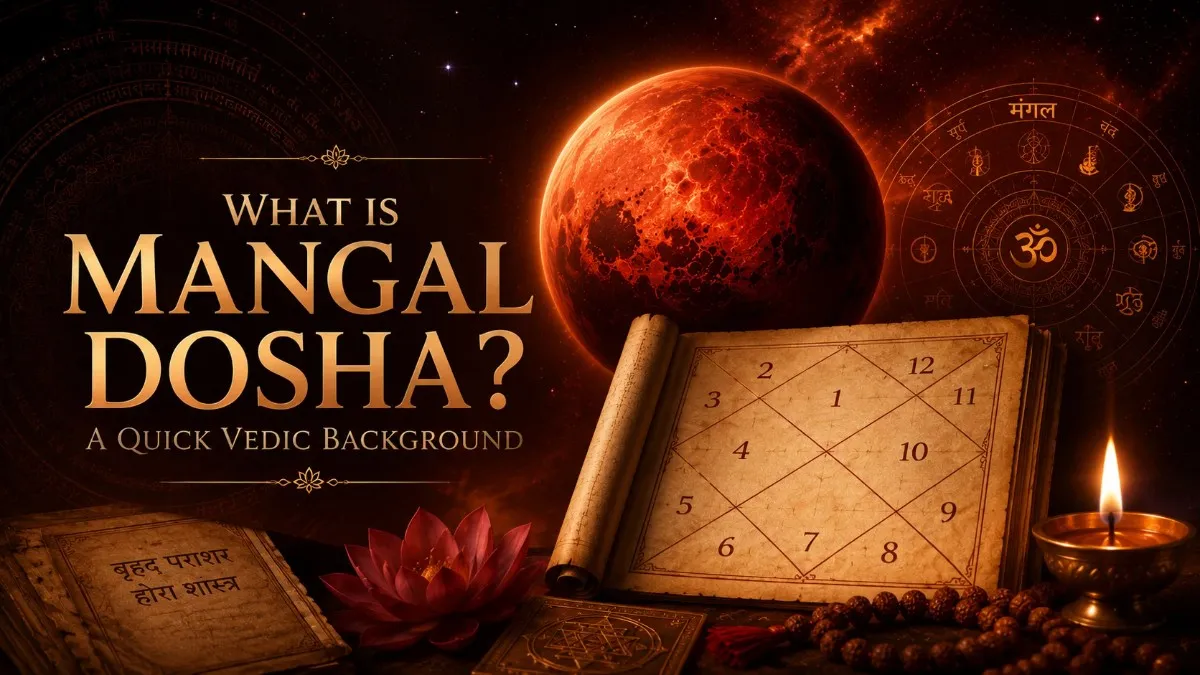
In Vedic Astrology, Mangal (Mars) is the planet of energy, courage, and action. Mangal Dosha, also known as Kuja Dosha or Bhom Dosha, occurs when Mars is placed in certain houses of your birth chart - primarily the 1st, 2nd, 4th, 7th, 8th, or 12th house.
Ancient texts like the Brihat Parashara Hora Shastra describe Mars as a fiery, aggressive planet. When it sits in these specific houses, classical astrologers believed it could create friction in marital life - hence the long-standing tradition of checking for Manglik status before marriage in many Indian families.
Marriage in Vedic tradition is considered a sacred union of two energies. Mars governs willpower, conflict, and physical vitality - qualities that, in excess or imbalance, can create friction between partners. This is why Manglik dosha is taken seriously during Kundli matching, alongside the traditional Ashtakoot Milan system.
The Houses That Define a Manglik Chart
Not every placement of Mars creates the same intensity of Dosha. Here is how it generally breaks down:
It's worth noting that the intensity of Mangal Dosha depends heavily on which house Mars occupies, what sign it's in, and which other planets aspect it.
Absolutely not - and this is where I see the most misunderstanding. Mars in its own sign (Aries or Scorpio) or in exaltation (Capricorn) behaves very differently than a debilitated or heavily afflicted Mars. A chart can technically be "Manglik" yet remain remarkably balanced if Mars receives benefic aspects from Jupiter or Venus.
Many people don't realise that Mangal Dosha has well-documented cancellation rules in classical texts:
This is precisely why I always tell families: never reject a match based solely on the word "Manglik" without a proper chart reading. The actual strength and placement matters far more than the label itself.
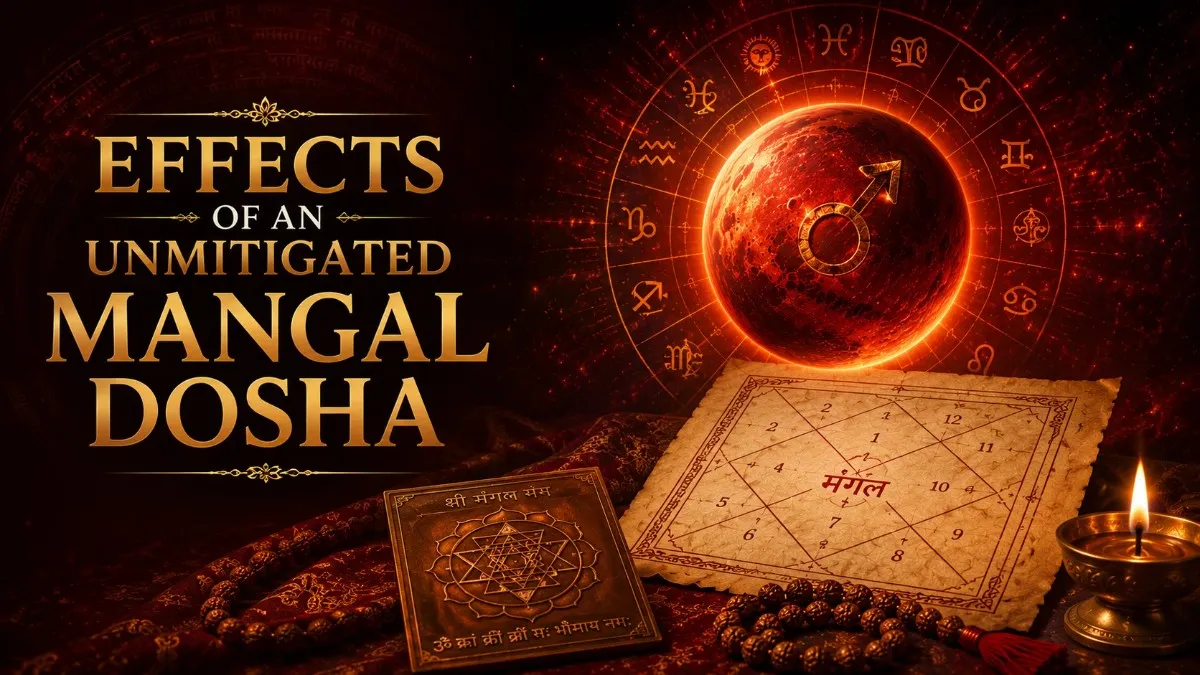
When the Dosha is strong and unaddressed, classical astrology associates it with:
I want to emphasise - these are tendencies, not guarantees. A chart is a map of potential, not a fixed sentence.
Before applying any of the remedies below, please consult a qualified, real-life astrologer who can study your actual birth chart in full. Astrology works differently for each individual - the same planetary placement can mean very different things depending on the rest of your Kundli, and what helps one person may not be the right approach for another. Please treat the points below as general awareness, not a do-it-yourself prescription.
With that said, here is what is traditionally recommended once a qualified astrologer confirms the Dosha and its intensity:
Again, the right remedy depends entirely on your unique chart - this is not a one-size-fits-all list.
1. Does Mangal Dosha mean my marriage is doomed? No. It indicates certain tendencies that need awareness and, where needed, balancing - not an unavoidable outcome.
2. Can two Manglik people marry each other safely? Yes, this is actually one of the most traditional and recommended remedies, as the doshas are believed to neutralise each other.
3. Does Mangal Dosha disappear with age? Many classical texts suggest the intensity reduces after a certain age (commonly cited around 28), though this should be confirmed through your specific chart.
4. Is Kumbh Vivah really necessary for everyone? No. It's typically recommended only for stronger placements, such as Mars in the 7th or 8th house. An astrologer's assessment is essential before performing it.
5. Can a non-Manglik person marry a Manglik without issues? It is possible, especially when other cancellation factors exist in the chart, but this should always be assessed individually rather than assumed.
Mangal Dosha is not a flaw in you - it is a feature of your unique cosmic blueprint. Like every placement in Vedic Astrology, it carries both challenge and strength: the same fire that creates friction can also bring courage, protection, and passion to a marriage when understood and channelled well.
If there is one thing I hope you take from this blog, it is this - don't let a label decide your future. Let knowledge, guided by an experienced eye, decide it instead.
If you are curious about your own Mangal Dosha status, marriage compatibility, or want a detailed Kundli matching session before an important decision, I warmly invite you to reach out for a personalised consultation.
If you'd like clarity on your own Mangal Dosha status, are exploring Kundli matching before marriage, or simply want guidance rooted in genuine Vedic principles, I'm here to help. Reach out for a personalised consultation, in-person at my Kolkata chamber or online - wherever you're most comfortable.
Call/WhatsApp: +91 7477886099 Email: astro@anjanshastri.com Website: anjanshastri.com Location: Kolkata, West Bengal

Kojagari Lakshmi Puja 2026: Date, Puja Vidhi, Alpana and What Maa Lakshmi Blesses on Sharad Purnima
21/10/2026
Rahu Mahadasha: Effects, Challenges and Remedies Every Native Should Know
14/10/2026
Maa Durga's Arrival and Departure on Gaja, Nauka, Doli or Ghora: What the Vahana Predicts for the Year Ahead
07/10/2026
Rudraksha Mukhi Guide: Which Rudraksha Suits Which Problem and How to Wear It Correctly
23/09/2026
© 2024 Dr Anjan Shastri . All Rights Reserved | Design & Developed by DITS