Baguiati, Kalighat, Bardhaman, Midnapore, Bankura, Arambagh
+91 7477886099



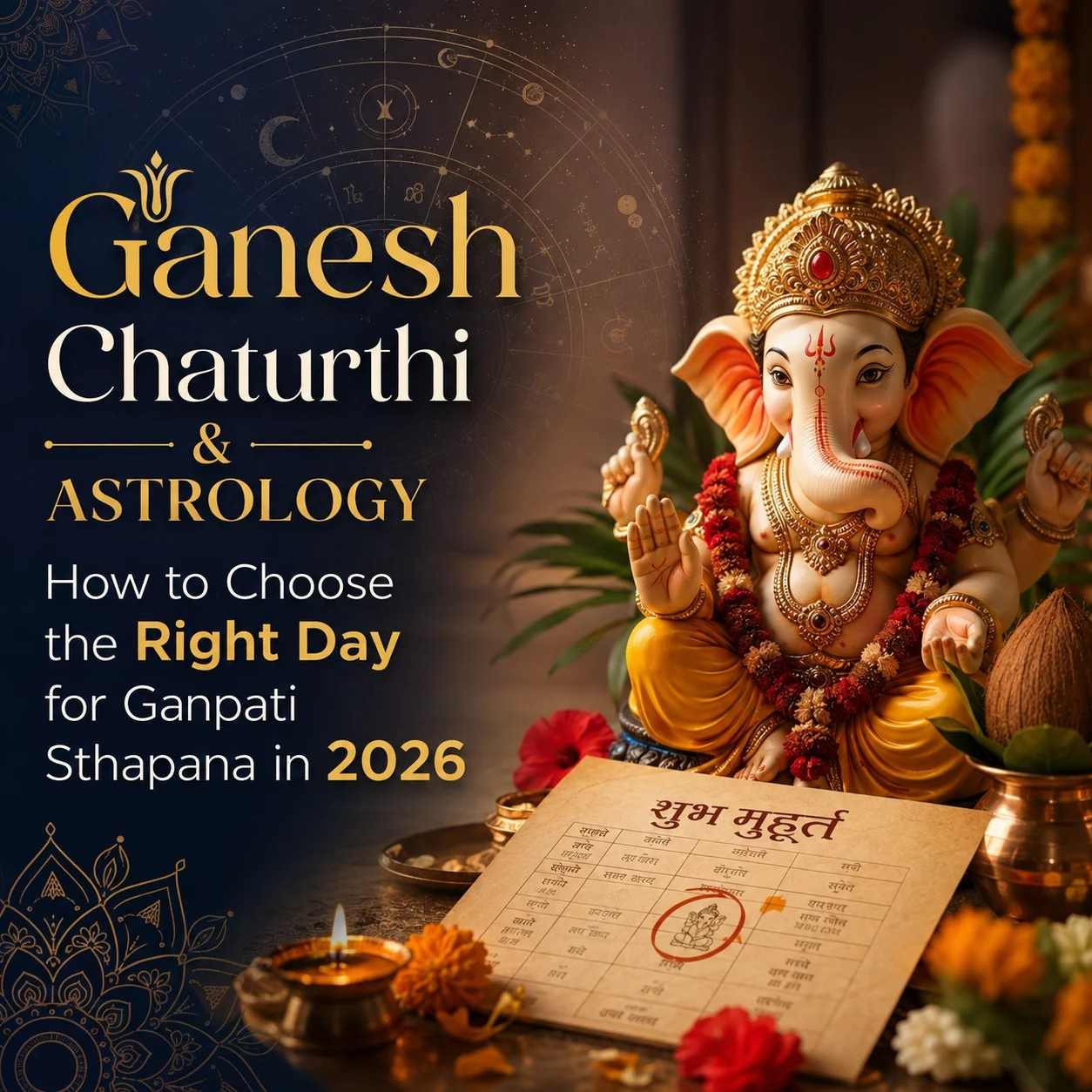
Every year, around this time, my phone starts ringing a little more than usual. The question is almost always the same: "Anjan ji, we've fixed a day and time for Ganpati Sthapana, but is it really auspicious for our family?" I understand the worry. Bringing Ganpati Bappa home isn't just a ritual, it's an emotional moment, and nobody wants to begin it on the wrong note.
In this blog, I, Anjan Shastri, want to walk you through how Vedic Astrology actually helps you choose the right moment for Ganpati Sthapana 2026, what the Panchang really tells us, the mistakes I see families make every single year, and how you can bring a little more confidence into your celebrations. No jargon, no fear-mongering, just the wisdom that has guided our households for generations.
Ganesh Chaturthi marks the birth of Lord Ganesha, the remover of obstacles and the deity we invoke before starting anything new. In Vedic tradition, this isn’t treated as a fixed calendar date the way we think of birthdays today. It is tied to the Chaturthi Tithi of Shukla Paksha in the month of Bhadrapada, a lunar timing that shifts slightly each year.
Our sages understood something modern life often forgets, that the moment we begin something carries its own energy. Just as a farmer doesn’t sow seeds on any random day but waits for the right season, our ancestors believed that inviting a deity into the home should also align with a time when the cosmic energies support new beginnings. That is the entire idea behind a Shubh Muhurat, it isn’t superstition, it’s a way of working with nature rather than against it.
The entire festival hinges on the correct identification of the Chaturthi Tithi. If Sthapana is done outside this window, tradition holds that the ritual loses its potency. This is the very first thing I check for any family planning Ganpati Sthapana 2026, the precise span of the Tithi as it falls that year, because a Tithi can begin or end at any hour of the day, not necessarily at sunrise.
The Panchang is our five-limbed almanac, and for a ritual like this, three elements matter most:
● Tithi: Confirms the exact window during which the Chaturthi is active.
● Nakshatra: Certain lunar constellations are considered more favourable for beginning worship and installation rituals.
● Rahu Kaal: This inauspicious period repeats daily and must always be avoided for Sthapana, regardless of how convenient the timing seems.
I always tell my clients, don’t just look at the date on a calendar app. The Panchang for your specific city and day is what actually matters.
Over the years, I have noticed the same handful of errors repeating across households:
● Choosing a time purely because it’s convenient for relatives to gather, ignoring Rahu Kaal.
● Assuming the Tithi lasts the entire day, when it may actually end by early afternoon.
● Copying the Muhurat announced for a different city or time zone.
● Ignoring the moon’s position, which subtly affects the mood and energy of the household during the festival.
In Vedic Astrology, the Moon governs the mind, emotions, and domestic harmony, all of which are central to how a festival is experienced at home. A well-placed Moon on the day of Sthapana is believed to support a calmer, more devotional atmosphere throughout the ten days of worship. I recall one family from Salt Lake who consulted me last year, worried because a family elder was unwell right before the festival. Once we identified a slightly better window later in the same Tithi, the whole household felt more at ease, and they told me the days that followed felt noticeably more peaceful.
Kundli analysis isn’t just for marriage matching or career decisions. Your individual birth chart can reveal which days within the festival period are most supportive for you personally, whether for the Sthapana itself, or for undertaking a special vow, fast, or puja. If Jupiter or the Moon in your chart is currently under stress, a personalised reading can help you choose a more supportive approach to your observance this year.
Once the Muhurat is settled, placement matters just as much. A few principles I always share with families:
● Place the idol facing West so that you face East while performing Aarti, considered highly favourable.
● Avoid placing Ganpati directly under a staircase or in a cluttered corner.
● The North-East zone of the home, our Ishaan corner, is traditionally the most sattvic spot for the idol.
● Keep the area clean and well-lit throughout the ten days, symbolic clarity supports spiritual clarity.
Here in Bengal, Ganesh Chaturthi doesn’t carry the scale of celebration you’ll see in Maharashtra, but its popularity has grown noticeably in Kolkata over the last decade, especially among the business community and in mixed neighbourhoods. Many of my Kolkata clients observe a simpler, one-day or three-day Sthapana rather than the full ten-day cycle. The astrological principles remain identical, only the duration of worship differs, so the correct Tithi and Muhurat matter just as much, regardless of how many days you observe.
Here is what I recommend to every family reaching out to me about Ganpati Sthapana 2026:
● Consult a verified local Panchang for your city, not a generic national one.
● Note the exact start and end time of the Chaturthi Tithi, don’t assume it covers the full day.
● Always cross-check Rahu Kaal timings before finalising your Muhurat.
● If your family has specific concerns, health, finances, harmony, consider a brief Kundli consultation to personalise the timing.
● Prepare the Vastu-correct placement spot a day or two in advance so there’s no last-minute rush.
Because the Tithi itself has a defined start and end time each year, and performing the ritual outside that window, or during Rahu Kaal, is considered to reduce its auspiciousness according to Vedic tradition.
Yes. Tithi timings are calculated based on sunrise and planetary positions specific to your location, so always use a Panchang calculated for your own city rather than a generic one.
It won’t change the festival’s core timing, but it can help you choose which days within the period are most supportive for you personally, and highlight any remedies worth considering this year.
It isn’t mandatory, but aligning the idol’s placement with Vastu principles is believed to enhance the positive energy of the space during worship.
That is completely fine, especially common here in West Bengal. The astrological correctness of the Tithi and Muhurat matters far more than the number of days you observe.
Ganpati Bappa is known as Vighnaharta, the remover of obstacles, and inviting him into your home with the right intention and the right timing is really about creating a space of clarity and devotion. You don’t need to feel overwhelmed by the astrology of it all, just approach it with sincerity, verify your Panchang carefully, and let the ritual bring your family the peace it’s meant to.
If you’d like a personalised Muhurat or Kundli-based guidance for Ganpati Sthapana 2026, I am always happy to help you find the timing that feels right for your household.
If you would like personalised guidance on choosing the right Muhurat for your Ganpati Sthapana, Anjan Shastri offers consultations both in person in Kolkata and online. Reach out using the details below to book your session.
Call/WhatsApp: +91 7477886099 Email: astro@anjanshastri.com Website: anjanshastri.com Location: Kolkata, West Bengal

Kojagari Lakshmi Puja 2026: Date, Puja Vidhi, Alpana and What Maa Lakshmi Blesses on Sharad Purnima
21/10/2026
Rahu Mahadasha: Effects, Challenges and Remedies Every Native Should Know
14/10/2026
Maa Durga's Arrival and Departure on Gaja, Nauka, Doli or Ghora: What the Vahana Predicts for the Year Ahead
07/10/2026
Rudraksha Mukhi Guide: Which Rudraksha Suits Which Problem and How to Wear It Correctly
23/09/2026
© 2024 Dr Anjan Shastri . All Rights Reserved | Design & Developed by DITS