Baguiati, Kalighat, Bardhaman, Midnapore, Bankura, Arambagh
+91 7477886099


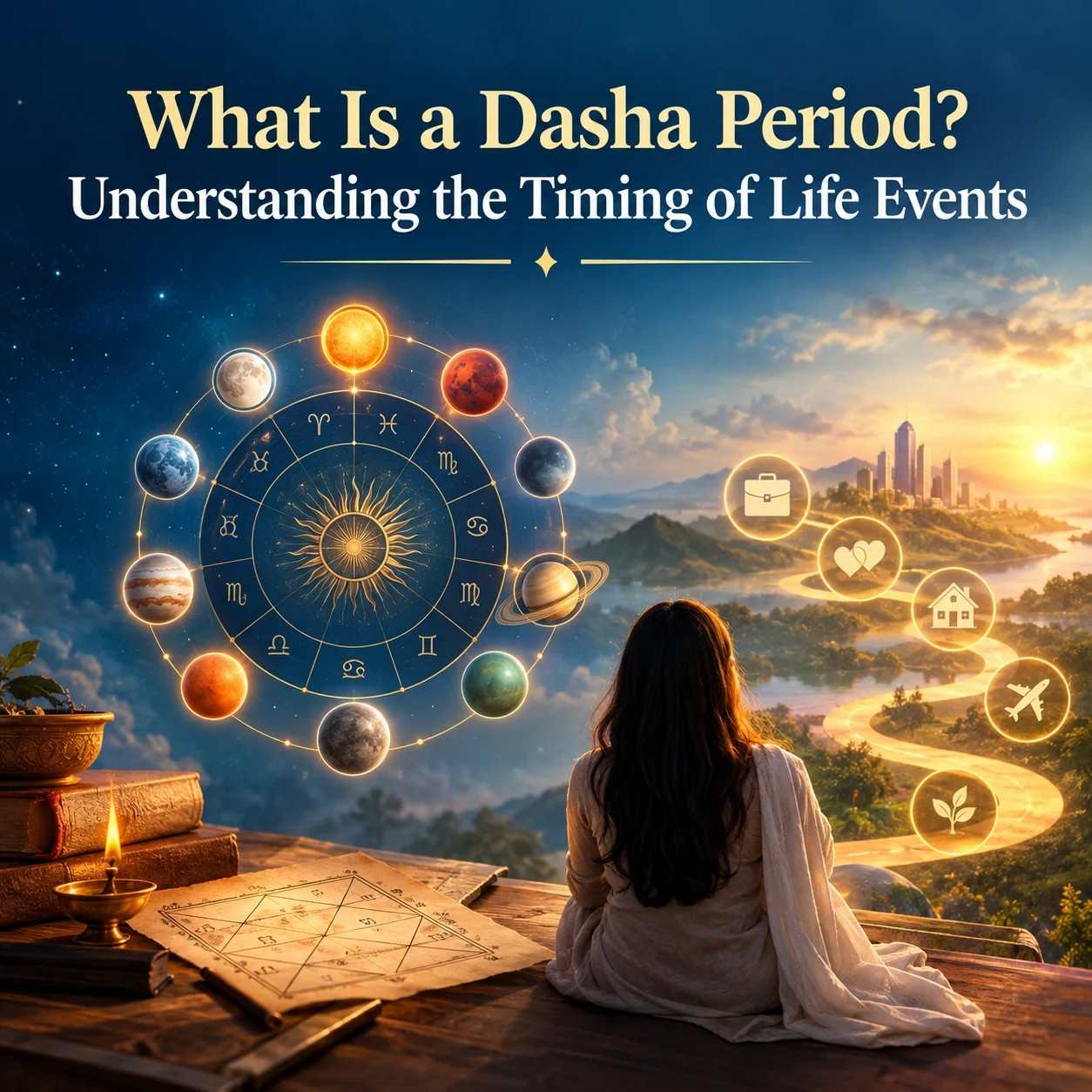
Why does life sometimes feel stuck for years, and then suddenly everything moves at once - a new job, a marriage, a move to a new city, all within a matter of months? I am Anjan Shastri, and I hear this question in my consultation room more often than almost any other. People come to me feeling like they are living on two different clocks: one where nothing changes, and one where change refuses to slow down.
The answer, in Vedic astrology, almost always leads back to one concept: the Dasha period. In this blog, I want to walk you through what a Dasha period actually is, how it is calculated, and why understanding your own Dasha can help you approach life's ups and downs with far more clarity and far less anxiety.
The idea of planetary time-cycles is not new - it comes to us from classical Vedic texts like the Brihat Parashara Hora Shastra, attributed to the sage Parashara. Among the many Dasha systems described in our scriptures, the Vimshottari Dasha has stood the test of time as the most widely used and trusted system across India. It has guided astrologers for centuries in mapping how a person's birth chart timing unfolds through real, lived experience - not as vague symbolism, but as a structured timeline.
In the simplest terms, a Dasha is a planetary period - a window of time during which one particular planet takes the lead role in influencing your life. Think of your Kundli (birth chart) as a stage, and each planet as an actor who gets its turn in the spotlight.
While a planet is "running" its Dasha, its qualities, its placement, and its relationships with other planets in your chart become far more active and noticeable in your day-to-day life. This is why two people with similar struggles can have very different journeys - because they are, quite literally, being governed by different planetary energies at different times.
The Vimshottari Dasha system divides a person's life into a repeating 120-year cycle, shared among the nine grahas (planets) - Sun, Moon, Mars, Rahu, Jupiter, Saturn, Mercury, Ketu, and Venus. Each planet governs a fixed number of years:
These add up to 120 years - a number our sages considered a full life cycle. Not everyone experiences every Dasha in full (life has its own length, after all), but the sequence and starting point are unique to each individual's chart.
This is where people often get confused, so let me simplify it.
A Mahadasha is the "major period" - the years ruled by one main planet, sometimes lasting anywhere from 6 to 20 years. Within every Mahadasha, there are smaller sub-periods called Antardasha, ruled by each of the nine planets in turn.
For example, if you are running a Venus Mahadasha, you will pass through a Venus-Venus Antardasha, then a Venus-Sun Antardasha, then Venus-Moon, and so on. It is really the combination - the Mahadasha planet blended with the Antardasha planet - that gives us the fine-grained texture of what a particular year or two will feel like.
Here is something many people don't realise: your Dasha calculation does not begin from your date of birth in a simple, linear way. It begins from your Moon's nakshatra (lunar constellation) at the exact moment of your birth.
Each nakshatra is ruled by one of the nine planets, and your very first, "running" Dasha at birth is determined by:
This is precisely why an accurate birth time is so essential for correct Dasha predictions - even a difference of a few minutes can shift the starting balance meaningfully.
Every planet carries its own themes, and its Dasha tends to bring those themes to the forefront:
I once had a client come to me deeply worried because her career had gone quiet for nearly two years. When we looked at her chart, she was in a Ketu Antardasha within a Venus Mahadasha - a natural phase of inward reflection before Venus's more outward, expansive themes returned. Within a year of that Antardasha ending, she had two job offers. The planet hadn't "failed" her; it was simply doing what Ketu periods are meant to do.
A Dasha change, called a Dasha Sandhi, often brings a noticeable shift. Common signs include:
If you've felt like you're "between two versions of your life," it is very often a Dasha Sandhi at work.
I want to gently clear up a few myths I hear constantly in consultations:
If you'd like to approach your current phase with more clarity, start here:
How long does a Dasha period last?
It depends on the planet - Mahadashas range from 6 years (Sun) to 20 years (Venus), while Antardashas within them can last anywhere from a few months to several years.
Can Dasha periods be changed or reduced?
No, the sequence and duration are fixed at birth based on your Moon's nakshatra. However, remedial measures can help you navigate a difficult Dasha with more ease.
What happens during a Sade Sati vs a Dasha change?
Sade Sati is a Saturn transit cycle lasting about 7.5 years, independent of your Dasha. When Sade Sati and a challenging Dasha or Antardasha overlap, the effects can feel more pronounced, which is why both should be read together.
Do all Dasha periods feel difficult?
Not at all. Many Dashas, like Jupiter or Venus, are associated with growth, comfort, and expansion. Even traditionally "tough" planets bring valuable lessons and long-term rewards.
Why do two people with the same Dasha have different experiences?
Because the Dasha planet's effect depends on its placement, strength, and relationships within each individual's unique birth chart - no two charts are identical.
Understanding your Dasha period is not about fearing what's ahead - it's about reading the rhythm of your own life with more patience and trust. Every planetary period, difficult or joyful, has a purpose in your journey. When you know which chapter you're in, you stop fighting the story and start writing it with intention.
If you'd like a detailed reading of your current Mahadasha and Antardasha, or guidance on navigating an upcoming transition, I'm here to help you see your path more clearly.
Whether you have a quick question or need an in-depth Dasha and Kundli reading, I welcome you to reach out for a personal consultation. I offer both in-person sessions in Kolkata and online consultations for clients across India and abroad.
Call/WhatsApp: +91 7477886099 Email: astro@anjanshastri.com Website: anjanshastri.com Location: Kolkata, West Bengal

Kojagari Lakshmi Puja 2026: Date, Puja Vidhi, Alpana and What Maa Lakshmi Blesses on Sharad Purnima
21/10/2026
Rahu Mahadasha: Effects, Challenges and Remedies Every Native Should Know
14/10/2026
Maa Durga's Arrival and Departure on Gaja, Nauka, Doli or Ghora: What the Vahana Predicts for the Year Ahead
07/10/2026
Rudraksha Mukhi Guide: Which Rudraksha Suits Which Problem and How to Wear It Correctly
23/09/2026
© 2024 Dr Anjan Shastri . All Rights Reserved | Design & Developed by DITS