Baguiati, Kalighat, Bardhaman, Midnapore, Bankura, Arambagh
+91 7477886099


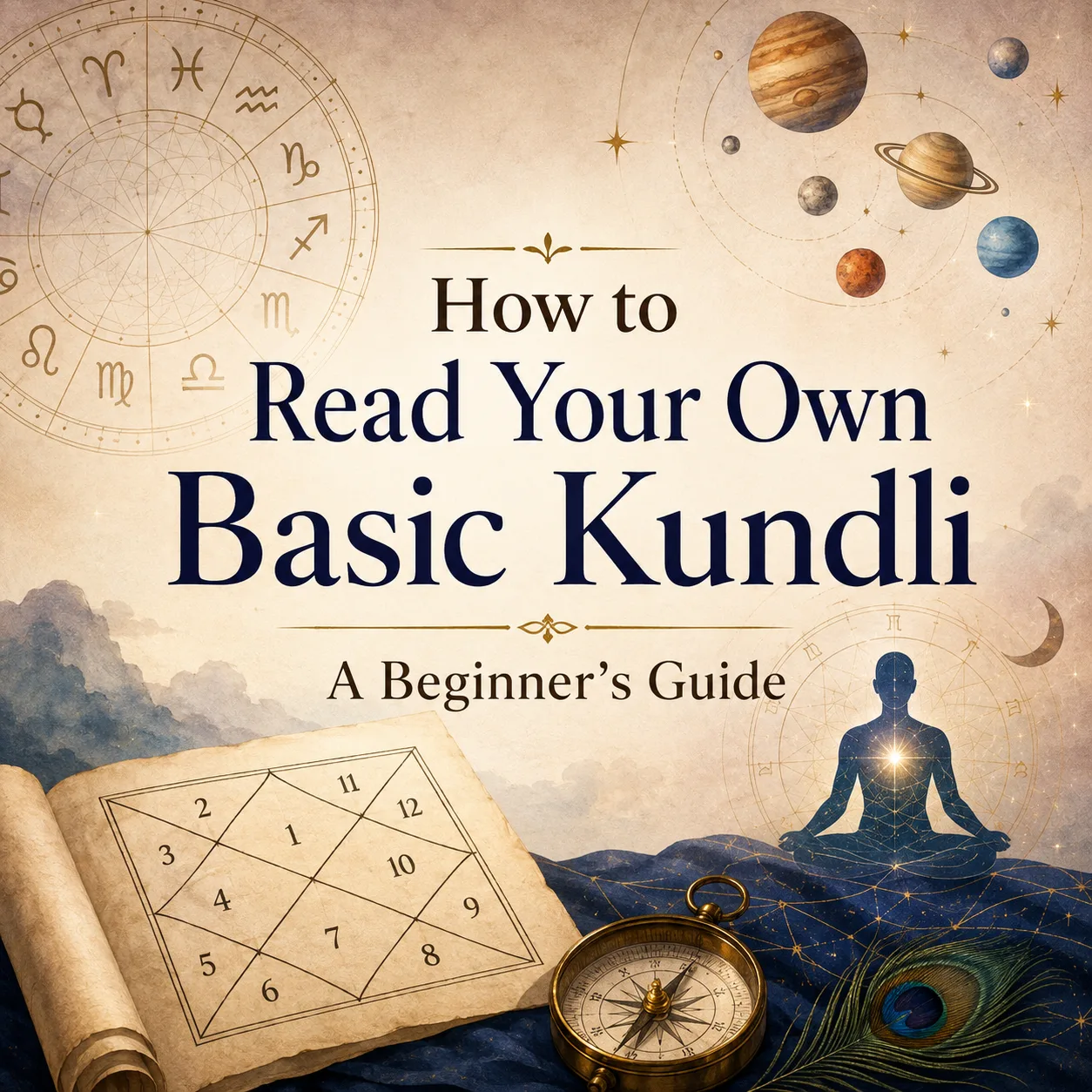
Have you ever opened your own kundli - maybe one your parents kept safely for years, or one you generated online in two minutes - and felt more lost than before you opened it? Rows of numbers, strange symbols, planets sitting in little boxes… and not one clue about what any of it means for your life.
I'm Anjan Shastri. In over two decades of consultations, this is one of the first things almost every client tells me: "Sir, I have my kundli, but I don't understand a word of it." It's a little like holding a map to your own house written in a language you were never taught.
In this guide, I want to change that. I'll walk you through how to read kundli basics in plain, everyday language - no jargon, no shortcuts, and nothing that contradicts the depth of Vedic Astrology. By the end, you'll be able to look at your own chart and actually recognise what you're looking at. This is exactly the kind of beginner astrology guide I wish someone had handed me when I started learning this science all those years ago.
The kundli, or birth chart, is not a modern invention. It comes from a tradition of Vedic Astrology that our sages developed by observing the sky with extraordinary patience, over generations, long before telescopes or computers existed. They mapped the position of the planets at the exact moment of a person's birth and understood, through careful observation across centuries, that this celestial snapshot carries deep meaning for that person's life. This knowledge has been passed down from guru to student for thousands of years, and even today, in the age of instant chart-generating apps, its foundation remains exactly the same as ancient science.
Your kundli is essentially a photograph of the sky taken at the exact moment you were born, from the exact place you were born. It records where each of the nine grahas (planets) was positioned among the twelve zodiac signs, and it plots this onto a chart divided into twelve houses.
A basic birth chart reading will typically show you:
● Your Lagna (Ascendant) - the sign rising on the eastern horizon at your birth
● The placement of all nine planets across the twelve houses
● Your Rashi (Moon sign) - where the Moon was positioned
● The dasha (planetary period) you are currently running

Each of the twelve houses in your chart governs a different area of life. You don't need to memorise all of them today, but a quick overview helps enormously when you're learning how to read kundli for the first time:
● 1st House - Self, personality, physical body
● 2nd House - Wealth, family, speech
● 4th House - Home, mother, emotional comfort
● 7th House - Marriage, partnerships
● 10th House - Career, public standing
● 12th House - Losses, foreign connections, spirituality
The remaining houses (3rd, 5th, 6th, 8th, 9th, 11th) cover siblings, children, health, sudden events, fortune, and gains respectively. Together, all twelve houses build the complete picture of a life.
If there is one thing I tell every beginner, it is this: find your Lagna first. Everything else in the chart is read in relation to it. Your Lagna is the sign that was rising on the horizon at the exact moment you were born, and it sits in the first house of your chart.
Think of your Lagna as the doorway into your chart. It shapes your personality, your physical appearance, and how the world experiences you. Without identifying it correctly, every other reading you attempt will be built on the wrong foundation.
Once you know your Lagna, look at where each planet sits — which house it occupies and which sign it is placed in. As a starting point, ask three simple questions for each planet:
1. Which house is this planet sitting in?
2. Which sign is it placed in - is this a comfortable sign for that planet, or a difficult one?
3. Is it alone in the house, or sharing space with other planets?
These three questions alone will tell you far more than staring blankly at the chart ever will.
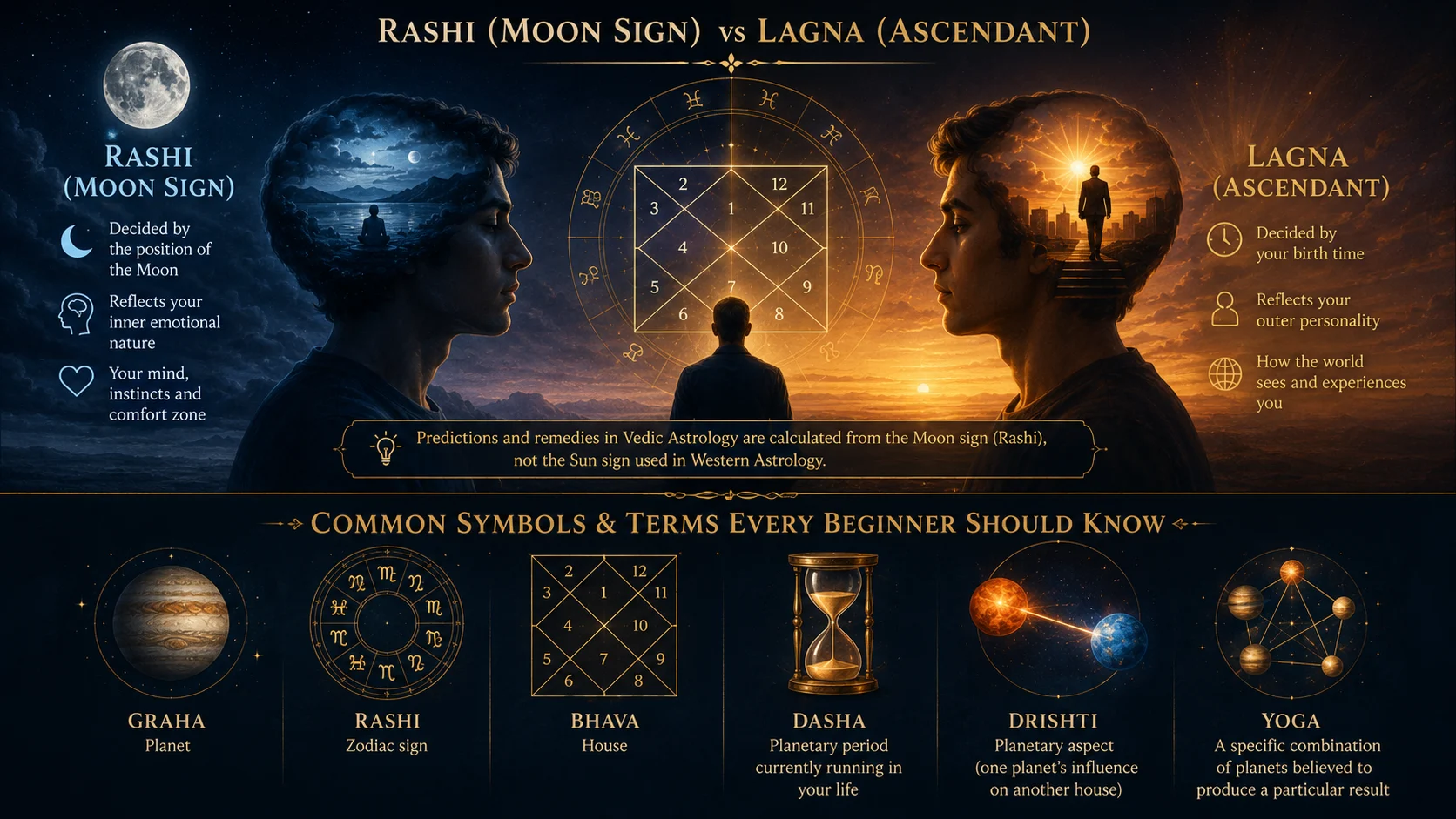
Many beginners confuse their Rashi with their Lagna, and it's an easy mistake to make. Your Lagna is decided by your birth time and reflects your outer personality. Your Rashi is decided by the position of the Moon and reflects your inner emotional nature - your mind, your instincts, your comfort zone.
In Vedic Astrology, most predictions and remedies are actually calculated from the Moon sign, not the Sun sign that Western astrology popularly uses. This is one of the biggest differences beginners need to understand early on.
● Graha - Planet
● Rashi - Zodiac sign
● Bhava - House
● Dasha - Planetary period currently running in your life
● Drishti - Planetary aspect (one planet's influence on another house)
● Yoga - A specific combination of planets believed to produce a particular result
This is where beginners often go wrong - assuming a planet is "bad" simply because it sits in a house they've read something negative about. A few gentle guidelines instead:
● A planet in its own sign or in exaltation tends to give strong, favourable results
● A planet in debilitation is weakened, but this is never the whole story - other placements can support it
● A planet surrounded by too many others, or badly aspected, may need more attention
I always caution my students: never judge a single placement in isolation. The chart works as a whole, and that is precisely why how to read kundli properly takes patience, not a single afternoon.
The next time you open your own chart, try this simple sequence:
4. Locate your Lagna (1st house) first
5. Note your Rashi (Moon sign) separately
6. Go house by house and note which planet sits where
7. Check which sign each planet occupies - comfortable or difficult
8. Identify your current dasha period
9. Resist drawing conclusions from a single placement
This simple habit is the real starting point of any how to read kundli journey, and it will serve you far better than jumping straight to predictions.
For a professional birth chart reading that goes beyond the basics.
Yes, the basics - Lagna, Rashi, and house placements are very learnable. Deeper predictive work still benefits from a trained astrologer's eye.
No. Your Rashi is calculated from the Moon's position using the sidereal system, while Western sun signs use a different calculation entirely.
Because a chart is read as a whole - house, sign, aspect, and dasha together. Different levels of experience can lead to different emphasis.
Yes, your Lagna especially depends on precise birth time. Even a difference of a few minutes can shift it.
I would gently advise against it. Self-reading is wonderful for understanding yourself better, but important decisions deserve a full consultation with an experienced astrologer.
Your kundli is not a verdict - it is a guide. It doesn't trap you; it simply shows you the tendencies and timings the universe has laid out, so you can walk your path with a little more awareness. Learning how to read kundli is really learning to understand yourself a little more deeply, one house and one planet at a time. Take it slowly, stay curious, and let the chart reveal itself to you gently.
If you'd like a detailed, personal birth chart reading from Kolkata's trusted name in Vedic Astrology and palmistry, I'm here to help. Reach out to us.
Call/WhatsApp: +91 7477886099 Email: astro@anjanshastri.com Website: anjanshastri.com Location: Kolkata, West Bengal

Kojagari Lakshmi Puja 2026: Date, Puja Vidhi, Alpana and What Maa Lakshmi Blesses on Sharad Purnima
21/10/2026
Rahu Mahadasha: Effects, Challenges and Remedies Every Native Should Know
14/10/2026
Maa Durga's Arrival and Departure on Gaja, Nauka, Doli or Ghora: What the Vahana Predicts for the Year Ahead
07/10/2026
Rudraksha Mukhi Guide: Which Rudraksha Suits Which Problem and How to Wear It Correctly
23/09/2026
© 2024 Dr Anjan Shastri . All Rights Reserved | Design & Developed by DITS